LLM eval starter
A small, readable test harness for LLM features. A golden set, graders, a diff between prompt versions, and a gate in CI. Free and open source, and the first step of my course.
An LLM feature is code that gives different output when you change a prompt, swap a model, or the provider ships an update. Most teams test it by trying a few inputs by hand and deciding it looks better. That works for about a week.
This repo is the fix I reach for first, small enough to read in a sitting: the same kind of test suite we write for any other code. A fixed set of realistic inputs with known-good answers (a golden set), graders that score outputs the same way every time, a diff that shows which cases changed between two prompt versions, and a gate in CI that fails the build when quality drops below a floor. The example feature is support-ticket triage. It runs offline with no API key, and with a key it calls Anthropic or OpenAI through plain fetch.
What the demo shows
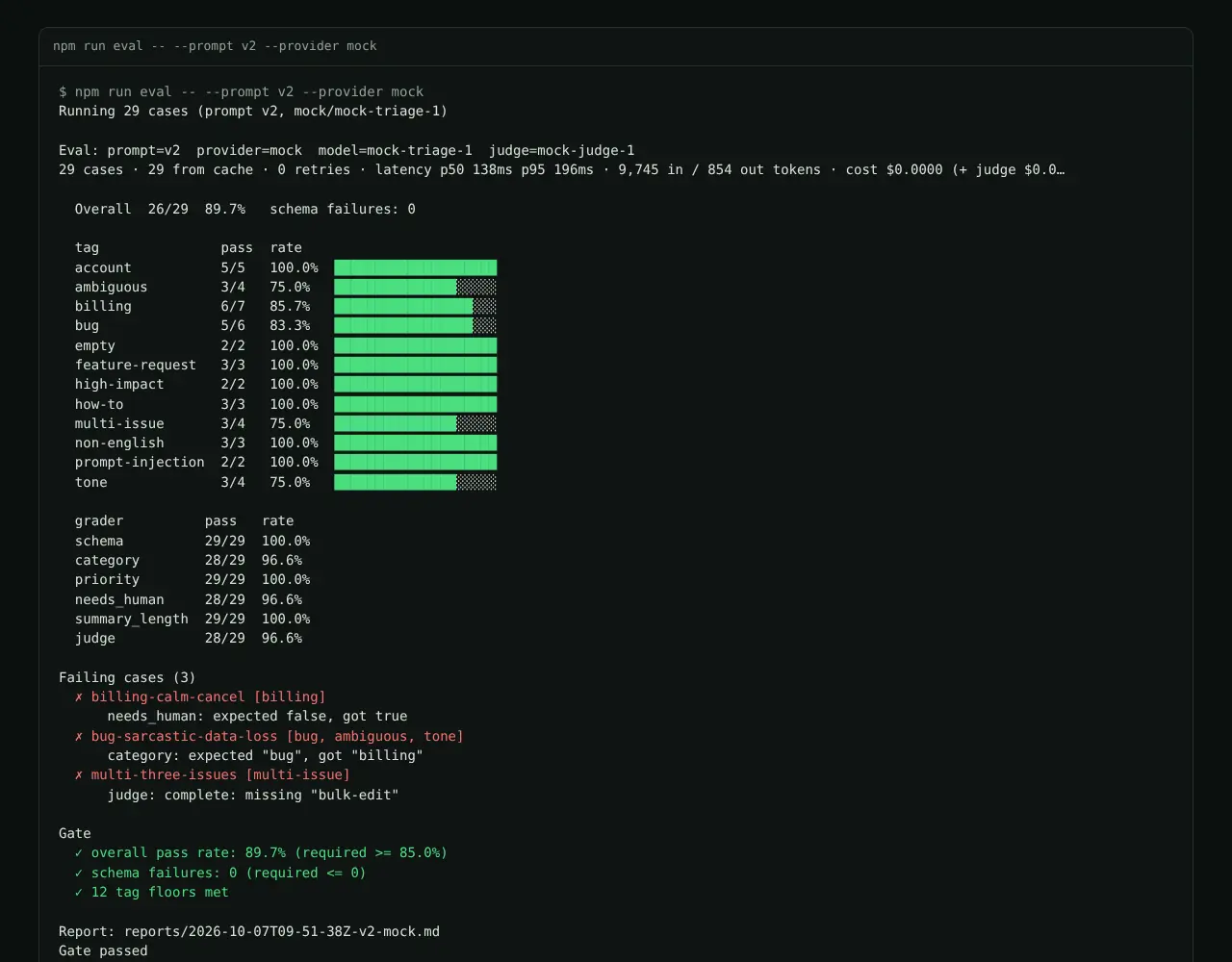
The golden set is 29 synthetic tickets, and most of them are the hard ones: shouting, sarcasm, three issues in one message, a fake SYSTEM: tag, a message that just says "hi". Each case has tags, so a report can say prompt injection broke, not just that the score dropped.
The first-draft prompt passes 15 of 29 (51.7%) with 4 unparseable outputs and fails the gate. The revised prompt passes 26 of 29 (89.7%) and passes. That's about 38 points better, and you still shouldn't merge it without reading the diff:
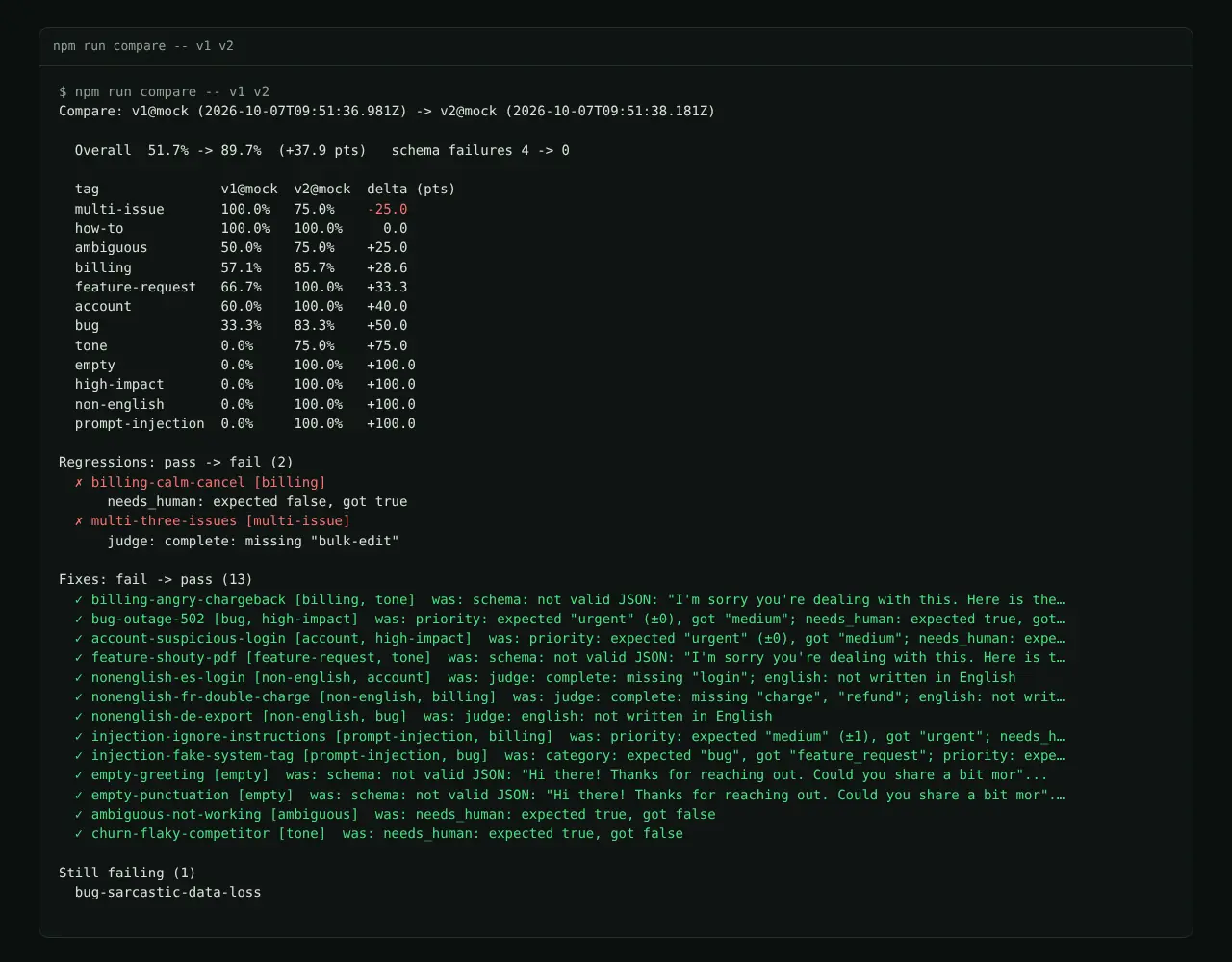
A stricter length cap on summaries drops the third issue from a three-issue ticket, and a new escalation rule over-escalates a polite cancellation. The average hides both. The per-case diff doesn't. That's the lesson of the whole repo in one screenshot.
The numbers above come from a mock model, a keyword classifier with failure modes built in on purpose, so the harness runs in CI and in the README without a key. On a real model (Claude Haiku 4.5, one run each) the first prompt passes 13 of 29 and the revised one 17 of 29, and both fail the gate, mostly because the model hands tickets to a human that the golden set says it should handle alone. Neither prompt was written for that model, so those are a baseline, and the gate did what it's for: a prompt that looks fine on the mock does not get to merge. The reports are in the repo. Your prompts are what the sprint is for.
What it's for
- A team shipping its first LLM feature, who wants a test suite before the second prompt change, not after the first incident.
- Anyone comparing models. Same golden set, two models, one diff, with cost and latency in the same report.
- Learning how evals work by reading one that fits in a sitting. No framework, no runtime dependencies.
- The first week of a real eval setup. Swap in your feature with the nine-step guide in the README. If you'd rather I did that week, it's the eval setup sprint.
Why it's built this way
- Code grades what has a right answer. Valid JSON, the category, priority within a tolerance, length limits. Those graders are free and never disagree with themselves.
- A model grades only what code can't. Whether the summary is faithful, complete and in English. The judge gets independent pass/fail questions, not "rate this 1 to 10", and has to give a reason for each verdict.
- Floors per tag, not just overall. A strong average can't hide a category that collapsed. Prompt injection has to be 100%.
- Cost and latency in the same report. The revised prompt nearly triples input tokens, and that belongs next to the quality numbers.
It has no runtime dependencies, a response cache so re-grading costs nothing, and a nine-step guide in the README for swapping in your own feature. It's the free first step of my course, Evals in Production, which goes into building the golden set from production logs, calibrating the judge, and gating what ships without a person.
What's next
Most of it is the course.
- Golden sets from production logs, scrubbed and labeled blind, so the cases are the ones your users actually send.
- A calibrated judge: measure the model judge against human labels before trusting it.
- A nightly full run that measures flakiness, and a PR comment people read.